
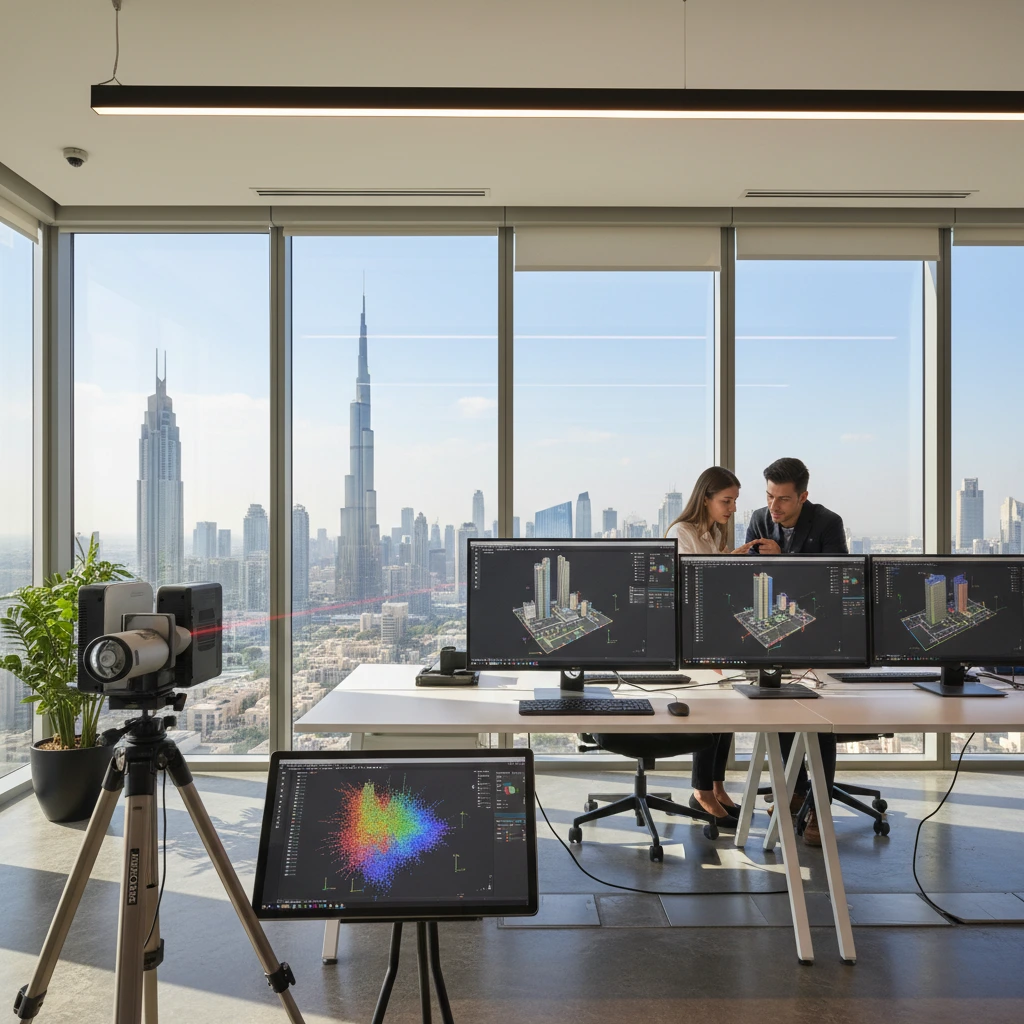
Imagine building a giant, complex LEGO set. Before you even snap the first two bricks together, you have a detailed instruction booklet. This booklet shows you every single piece, where it goes, and how it connects to everything else. You can see the finished model from every angle before you even start. What if building a skyscraper, a sprawling mall, or a luxury villa could be just as clear and predictable?
This is where Building Information Modeling, or BIM, comes in. It’s like a super-powered, 3D instruction manual for real buildings. And in a city of architectural wonders like Dubai, using architectural BIM modeling is no longer a luxury—it’s the key to creating accurate, smart, and sustainable buildings. This digital approach is changing the game for architects, engineers, and builders across the region.
This guide will walk you through what architectural BIM modeling in Dubai is all about. We’ll explore how it transforms confusing blueprints into intelligent digital models and why it’s the cornerstone of modern construction in the UAE and beyond.
What Exactly is Building Information Modeling (BIM)?
Let’s break it down. Traditional building design relied on 2D drawings—flat blueprints showing floor plans and elevations. If you wanted to see how the plumbing connected to the electrical system, you’d need to pull out two separate drawings and try to picture it in your head. This often led to on-site clashes, mistakes, and costly delays.
Building Information Modeling is much more than just a 3D model. It’s a process that creates a digital twin of a building. This isn’t just a pretty picture; it’s a data-rich model where every element, from a concrete beam to a light switch, contains information. You can click on a virtual window and see its manufacturer, its energy efficiency rating, and its cost.
This intelligent model becomes a single source of truth for everyone involved in the project. The architects, structural engineers, MEP (mechanical, electrical, plumbing) specialists, and construction teams all work from the same coordinated model. This collaborative approach is a core strength of BIM.
The Power of 3D Architectural BIM Modeling in Dubai
In a city that prides itself on pushing the boundaries of design, 3D architectural BIM modeling Dubai offers a massive advantage. It allows designers to visualize and test their ideas in a virtual environment before a single shovel hits the ground.
Think about the intricate designs of buildings like the Burj Khalifa or the Museum of the Future. BIM was instrumental in their creation. It allows for complex geometric shapes and innovative structures that would be nearly impossible to coordinate using old-school 2D drawings. Architects can walk through a virtual version of the building, checking sightlines, spatial flow, and the overall feel of the place.
This visualization isn’t just for aesthetics. It helps identify potential problems early. For example, a BIM model can instantly detect if a ventilation duct is scheduled to run through a structural beam. Finding this “clash” on a computer screen is a simple fix. Finding it during construction means cutting concrete, rerouting systems, and wasting time and money.
Why BIM is Essential for Construction in the UAE and Saudi Arabia
The construction boom in the Middle East, particularly in the UAE and Saudi Arabia, demands efficiency, speed, and quality. Governments and developers are increasingly mandating BIM for large-scale projects because its benefits are too significant to ignore.
Unlocking Efficiency with Professional BIM Services UAE
Projects in the UAE are known for their ambitious timelines. Professional BIM services UAE help meet these deadlines by streamlining the entire construction process. By using a shared digital model, communication between teams improves dramatically. Misunderstandings are reduced, and decisions are made faster because everyone has access to the same up-to-date information.
This leads to:
- Fewer Errors: Clash detection and virtual review cycles catch mistakes before they happen on-site.
- Reduced Rework: When things are built right the first time, the costly and time-consuming process of rework is minimized.
- Better Cost Management: BIM allows for more accurate cost estimations from the very beginning. The model can automatically calculate material quantities, helping to avoid over-ordering or shortages.
Driving Innovation with BIM Architecture Solutions Saudi Arabia
Saudi Arabia’s Vision 2030 is fueling giga-projects like NEOM and the Red Sea Project. These are not just ordinary construction projects; they are cities of the future built on sustainability and technology. BIM architecture solutions Saudi Arabia are fundamental to achieving these goals.
BIM supports sustainable design by enabling architects and engineers to perform energy analysis on the digital model. They can simulate how the building will perform in the local climate, testing different materials and orientations to maximize natural light and minimize heat gain. This helps create buildings that are not only beautiful but also highly energy-efficient, reducing their long-term operational costs and environmental impact.
For these massive projects, finding the right expertise is crucial. Many companies now rely on BIM modeling experts Saudi Arabia to ensure their projects are planned and executed with the highest level of digital precision.
Your Architectural BIM Modeling Company in Dubai
Choosing the right partner for your project is critical. An experienced architectural BIM modeling company in Dubai does more than just create 3D models. They become an integral part of your design and construction team, providing expertise and support throughout the project lifecycle.
Here’s what you should look for in a top-tier BIM provider:
- A Diverse Portfolio: Look for a company with experience across various project types, from residential towers and commercial complexes to public infrastructure. This shows they have the flexibility and knowledge to handle your specific needs.
- Expertise in Different BIM Dimensions: BIM isn’t just 3D. It extends to 4D (scheduling), 5D (costing), and even 6D (facility management). A skilled provider can offer these advanced services.
- Collaborative Approach: The best BIM consultants work closely with your team. They understand that BIM is a process, not just a product, and they facilitate collaboration between all project stakeholders.
- Mastery of BIM Design and Drafting UAE: A leading company will have a team proficient in the latest BIM design and drafting UAE software and standards. They ensure that all models are accurate, detailed, and comply with local regulations.
Whether you need comprehensive BIM modeling services UAE or specialized architectural BIM services Saudi Arabia, finding a firm with a proven track record is the first step toward a successful project.
The BIM Process: From Digital Blueprint to Finished Building
So, how does it all work in practice? The BIM lifecycle can be broken down into several key stages.
Stage 1: Conceptual Design (3D)
This is where the architect’s vision comes to life in a 3D model. The initial model is used to explore different design options, massing studies, and the building’s relationship with its surroundings. It’s a creative and fluid stage where big ideas are shaped.
Stage 2: Detailed Design and Clash Detection
Once the concept is approved, the model is developed with more detail. Structural engineers add the building’s skeleton, and MEP engineers add the vital systems—HVAC, plumbing, and electrical. This is where the power of coordination shines. Automated clash detection software is run on the federated model (a combination of all discipline models) to find and resolve thousands of potential conflicts.
Stage 3: Construction Documentation (4D & 5D)
With a clash-free model, the team can generate accurate construction drawings and documents. This is also where 4D and 5D BIM come into play. By linking the model to the project schedule (4D), teams can create a visual timeline of construction. Linking it to cost data (5D) provides real-time budget tracking.
Stage 4: Construction and Fabrication
The BIM model is used on-site to guide construction. Some contractors use tablets to view the model in the field, ensuring they are building exactly what was designed. The model can also be used to prefabricate components off-site with incredible accuracy, speeding up assembly on-site.
Stage 5: Handover and Facility Management (6D)
After construction, the final, as-built BIM model is handed over to the building owner. This digital twin is a goldmine of information for facility management. The maintenance team can use the model to locate equipment, access manufacturer information, and manage maintenance schedules, making building operations far more efficient.
The Future is Smart: BIM and the Rise of Smart Construction
The journey doesn’t end with BIM. Building Information Modeling is the foundation for the next wave of construction technology, often called “smart construction.” This includes integrating BIM with other digital tools to create even more intelligent and connected workflows.
For example, drones can be used to survey a construction site, and that data can be fed directly into the BIM model to compare progress against the plan. IoT (Internet of Things) sensors can be placed in the finished building to monitor performance in real-time, with the data visualized in the BIM digital twin.
This fusion of digital building design and real-world data is paving the way for buildings that are not just built smart but also operate smart. For a forward-thinking hub like Dubai, embracing this level of construction technology is essential to maintaining its position as a global leader in innovation.
Frequently Asked Questions (FAQs)
1. What is the main difference between 3D CAD and BIM?
While both involve creating 3D models, the key difference is the “I” in BIM—Information. A 3D CAD model is just a collection of geometric shapes (lines, surfaces). A BIM model is an intelligent database where each object contains rich information. For example, a wall in a BIM model “knows” what it’s made of, its fire rating, and its cost, whereas a wall in a CAD model is just a set of surfaces.
2. Is BIM only for large, complex projects?
Not at all! While BIM is essential for large projects, its benefits—like better coordination, fewer errors, and accurate material estimates—are valuable for projects of any size. Even a small residential project can benefit from the clarity and efficiency that a BIM process provides. Many firms offering professional BIM services UAE work on a wide range of project scales.
3. Does using BIM increase the initial design cost?
There can be a learning curve and initial investment in software and training. However, most projects see a significant return on this investment. The money saved by avoiding on-site rework, reducing material waste, and optimizing schedules almost always outweighs the initial cost. By catching errors in the digital phase, BIM prevents much larger expenses during the construction phase.
4. Can BIM be used for existing buildings?
Yes, absolutely. The process is called “Scan-to-BIM.” It involves using 3D laser scanners to capture the exact conditions of an existing building. This data is then used to create a highly accurate BIM model. This is incredibly useful for renovation, retrofitting, and facility management projects, as it provides a reliable digital record of the as-is state of the building.
5. What is LOD in BIM?
LOD stands for “Level of Development” (or sometimes “Level of Detail”). It is a scale that defines how much detail and information is included in a BIM element at different stages of the project. For example, at an early design stage (LOD 100), a wall might be just a simple mass. By the construction stage (LOD 400), that same wall element would include detailed information about its structure, materials, finishes, and assembly. LOD ensures that everyone on the project understands the usability and reliability of the model at each phase.