Why the Cheapest BIM Quote Always Costs the Most in UAE & Saudi Projects

The Saving Happens Once. The Cost Happens Three Times.

Every procurement manager comparing BIM quotes sees one number — the fee.

What doesn’t appear on that comparison sheet is what happens when the wrong vendor wins.

The saving on a low BIM quote is a fixed, one-time figure. The cost of fixing bad BIM is variable, compounding, and lands at the worst possible moment — during delivery, when the programme is already under pressure and there is no time to recover.

On UAE and Saudi fast-track projects, that sequence plays out consistently. The BIM fee gets approved. The vendor is appointed. The problems arrive three to four months later — not in the BIM team’s office but on site, in the coordination meetings, and in the authority submission portal.

By then, the original quote is irrelevant. The cost being absorbed is not.

Read More
Can Contractors Claim BIM Rework Costs in UAE & Saudi Arabia?

The Honest Answer: Rarely. And Almost Always Our Own Fault.

We’ve tried to recover BIM rework costs on projects where the entitlement was real and the commercial position was gone.

Not because the rework didn’t happen. It did. Not because we weren’t entitled. We probably were.

Because by the time we tried to build a claim, we had no notices served, no contemporaneous records, and a BEP that described everything except what triggers a variation.

Read More
The True Cost of BIM Failures on Contractor Margins

Introduction: BIM Rarely Fails Loudly

When BIM fails, it rarely causes an immediate crisis.

Instead, it creates:

  • gradual rework
  • coordination delays
  • authority resubmissions
  • scope expansion

Each of these may look small in isolation. Combined, they quietly reduce contractor margins.

On UAE and Saudi projects, this financial erosion is one of the most underestimated risks in contractor-led BIM execution.

Read More
Who Owns BIM on Contractor-Led Projects? And Why It Matters

Introduction: BIM Without Ownership Always Fails

On many contractor-led projects in the UAE and Saudi Arabia, BIM is mandatory.

Yet one question is rarely answered clearly:

Who actually owns BIM?

Not who produces models.
Not who attends coordination meetings.

But who owns:

  • coordination outcomes
  • design gaps
  • rework effort
  • authority compliance
  • and the commercial impact of BIM decisions

When ownership is unclear, BIM becomes a shared responsibility — and a shared failure.

Read More
BIM Rework: The Hidden Cost Contractors Rarely Track

Introduction: Rework That Never Enters the Cost Report

On most UAE and Saudi construction projects, rework is tracked on site.
But BIM rework is rarely recorded, measured, or claimed.

Yet BIM rework consumes:

  • hours of modeling
  • coordination cycles
  • senior engineer time
  • overtime and burnout

This article explains why BIM rework quietly drains contractor margins, and why most teams realize it only when it’s too late.

Read More
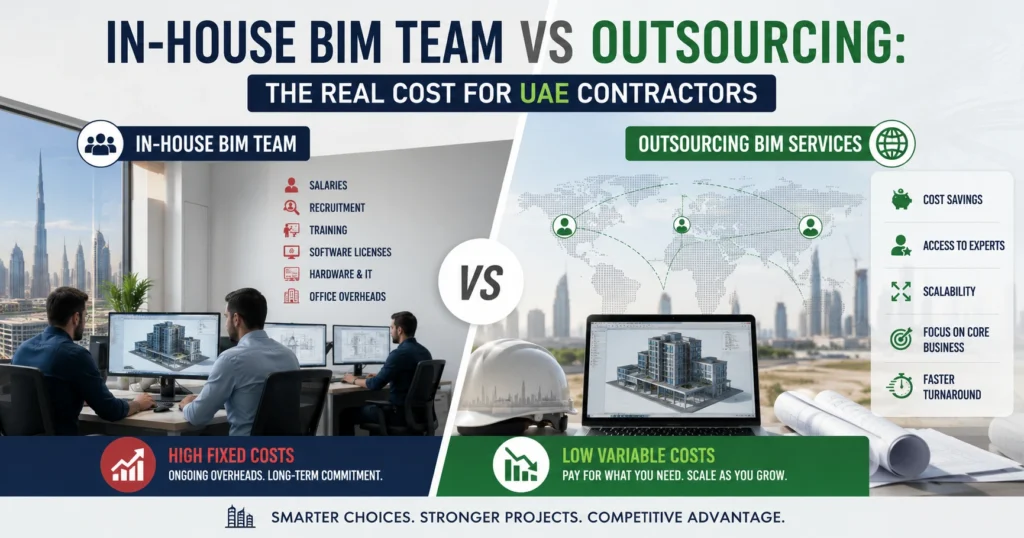
5 Reasons In-House BIM Teams Fail Under Fast-Track Construction Projects

Introduction: When BIM Becomes a Bottleneck

Fast-track construction projects are common in the UAE and Saudi Arabia.
Compressed timelines, overlapping design and construction, and aggressive handover dates are now the norm.

To manage this, many contractors invest in in-house BIM teams expecting better control, faster coordination, and reduced dependency on consultants.

Yet on many fast-track projects, BIM becomes a bottleneck instead of an accelerator.

This is not because in-house BIM teams lack skill or intent.
It is because they are often set up to fail under real project pressure.

Below are the five most common reasons in-house BIM teams fail on fast-track contractor-led projects.

Read More
Why BIM Fails in Contractor-Led Projects in UAE & Saudi Arabia

Introduction: The Contractor’s Reality

In the UAE and Saudi Arabia, BIM is no longer optional. It is written into contracts, demanded by clients, and enforced by authorities. Yet despite investing in BIM teams, software, and outsourcing partners, many contractors still face:

  • repeated model rework
  • authority rejections
  • coordination failures
  • and most importantly, unrecoverable costs

BIM does not fail because contractors don’t try. It fails because BIM is often introduced without commercial, contractual, and execution alignment.

This article explains why BIM fails on contractor-led projects — from the ground reality, not from theory.

Read More
Profit with BIM
AEC companies are making profits with BIM

We surveyed many Architecture & Planning companies, engineering consulting companies and contracting companies and asked them “Is BIM actually paying off by cost savings, higher quality, or client satisfaction?” Read more below about their responses.

AEC companies are making profits with BIM. This statement may seems interesting to many of you and you must be curious to know how it is being executed to have BIM for increasing profit margins despite heavy investment BIM needs to start with. Well it all starts by hiring a BIM outsourcing company with less upfront cost and start delivering projects demanding BIM implementation.

Read More
How 3D MEP Coordination differs from 2D MEP Coordination?

In this post, we will discuss about the two types of MEP coordination process and their challenges. One is 2D MEP Coordination and another is 3D MEP Coordination.

With the increase of complex MEP systems now-a-days, contracting companies are required to validate design received from design consultants and value engineer the design through spatial coordination and procurement of components to meet design requirements.

Read More