
In-House BIM Team vs Outsourcing: The Real Cost for UAE Contractors
In-House BIM Team vs Outsourcing: The Real Cost for UAE Contractors
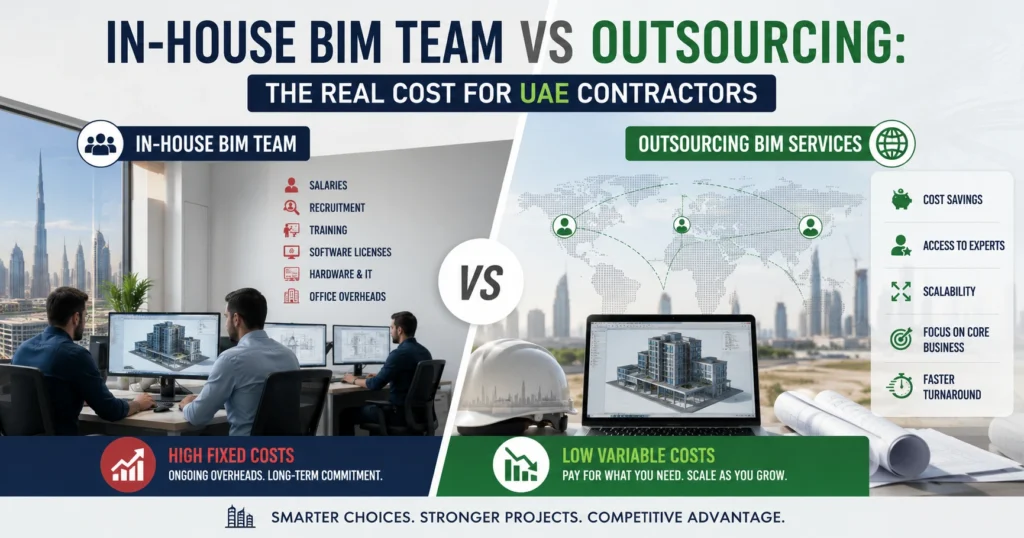
What Most MDs Actually See on the Cost Comparison
When a contractor’s MD or Commercial Manager compares building an in-house BIM team against outsourcing, the comparison usually looks like this:
In-house: one BIM manager plus two coordinators. Three salaries. Done.
Outsourcing: a monthly or project-based fee. Compared against those three salaries, it looks expensive.
That comparison is wrong — not because the salaries aren’t real, but because they represent less than 60% of what an in-house BIM team actually costs. The rest sits in line items that rarely make it onto the same spreadsheet.
When the full picture is assembled, the decision looks very different.
The Fully Loaded Cost of an In-House BIM Team in UAE
Salaries are the starting point, not the total. For every dirham spent on a BIM team’s payroll, a contractor in the UAE is also carrying:
Mandatory employment costs. UAE labour law requires end-of-service gratuity at 21 days per year of service for the first five years — approximately 8.33% of annual salary, accruing on every team member regardless of project load. Add visa fees, Emirates ID processing, and medical insurance, and the mandatory employment overhead runs well above what most cost comparisons account for.
Software licences. A BIM team needs Revit per seat, Navisworks Manage for clash detection, and a CDE platform for model management and submission. These are recurring annual costs — paid whether the team is fully utilised or sitting between projects. For a three-person team running the standard UAE contractor software stack, software alone becomes a meaningful fixed overhead that compounds year on year.
Hardware. BIM workstations capable of running coordinated federated models on complex MEP packages are not standard office machines. They carry a unit cost and a replacement cycle. Amortised across the team, hardware is a real line item that rarely appears on the comparison sheet against an outsourcing fee.
Recruitment. Every time a team member leaves — and in the UAE BIM market, turnover is structurally high — the contractor absorbs a recruitment fee, a notice and handover period, and a ramp-up window of four to eight weeks where delivery quality is reduced. BIM professionals in the UAE are in demand across the region. Movement is frequent. Recruitment is not a one-time cost; it is a recurring one.
Training and CPD. Dubai Municipality requirements evolve. Software versions update. LOD standards and IFC export requirements change with each new mandate cycle. Keeping an in-house team current requires continuous training investment — not a large number in isolation, but a real one when added to the stack above.
Add these together honestly across a twelve-month cycle and the fully loaded cost of an in-house BIM team is consistently and significantly higher than the salary line alone suggests.
The Costs Nobody Puts on the Spreadsheet
Beyond the loaded cost, two structural expenses almost never appear on any comparison — but they are real and they compound.
Bench time. An in-house BIM team is a fixed overhead. Costs run whether the team is fully utilised or not. For UAE sub-contractors, project pipelines are rarely perfectly continuous. Gaps between major packages are normal. During those gaps, salaries, licences, and visa costs continue — absorbed as overhead across the business with no project to recover them against.
Outsourced BIM scales with project demand. When there is no active scope, there is no cost. That structural difference is not visible on a comparison sheet built around three salaries versus a monthly fee.
Turnover and ramp-up. Every departure from an in-house BIM team triggers three overlapping costs: recruitment fees, a ramp-up period where the replacement is not yet at full productivity, and institutional knowledge loss that is hard to quantify but very easy to feel on a live project.
An outsourced BIM partner carries none of this risk back to the contractor. Team continuity, knowledge retention, and staff management sit with the provider. The sub-contractor gets consistent delivery without absorbing the disruption.
What Outsourcing Actually Costs — and What It Removes
A well-structured outsourced BIM engagement covers a dedicated team sized to the project scope, software and hardware supplied by the provider, QA and compliance management, submission preparation, and coordination support.
The fee is a single visible number. What it removes — employment overhead, bench time exposure, recruitment cost, turnover risk, software and hardware investment — is not visible on the comparison sheet, but the removal is real and it accrues across every month of the engagement.
The contractors who make this comparison accurately — total loaded cost of in-house versus total delivered cost of outsourcing, including structural risks — almost always find the gap is smaller than the salary comparison suggested and the risk profile is dramatically different.
The contractors who compare on salaries alone consistently underestimate what their in-house team actually costs.
The Decision That Actually Matters
This is not an argument that outsourcing is always right. For large contractors with continuous, high-volume BIM demand across multiple simultaneous packages, a well-managed in-house team can be the right model.
For most UAE and Saudi sub-contractors — where project pipelines are project-by-project, BIM demand peaks and troughs with package delivery, and the true overhead of a standing team rarely gets accounted for accurately — the in-house default deserves a harder look than it usually gets.
The right question is not “which costs less on the salary line?”
It is: “What does each model actually cost, fully loaded, across a twelve-month operating cycle — and which one delivers better BIM under the conditions our projects actually run in?”
That is the comparison worth making before the next hiring decision gets signed off.
Frequently Asked Questions
1. Is outsourcing BIM more cost-effective than maintaining an in-house BIM team in the UAE?
For many UAE contractors and subcontractors, outsourcing BIM can be more cost-effective because it eliminates expenses related to recruitment, employee benefits, software licenses, hardware upgrades, training, and bench time. The overall value depends on project volume and long-term BIM requirements.
2. What hidden costs are associated with an in-house BIM team?
Beyond salaries, contractors must account for visa costs, medical insurance, end-of-service gratuity, software subscriptions, high-performance workstations, recruitment expenses, employee turnover, and ongoing training. These costs can significantly increase the total cost of ownership.
3. When does it make sense to build an in-house BIM team?
An in-house BIM team is often a good option for large contractors with a consistent pipeline of BIM-intensive projects throughout the year. Continuous demand helps maximize team utilization and justify the investment in staff, software, and infrastructure.
4. How does outsourcing BIM reduce project delivery risk?
A professional BIM outsourcing partner provides access to trained specialists, established workflows, quality assurance processes, and scalable resources. This reduces the risks associated with staff turnover, recruitment delays, and fluctuating project workloads.
5. What should contractors compare when evaluating in-house BIM versus outsourcing?
Contractors should compare the fully loaded annual cost of an in-house team—including salaries, benefits, software, hardware, training, recruitment, and downtime—against the total outsourced service cost. Evaluating both financial and operational risks provides a more accurate basis for decision-making.
Vee7 delivers structured BIM for sub-contractors and specialist contractors across UAE and Saudi Arabia — project-scoped, commercially accountable, without the overhead of a standing team. If that comparison is worth running for your business, the conversation starts here.
Read also –
- Why the Cheapest BIM Quote Always Costs the Most in UAE & Saudi Projects
- BIM vs BOQ: Where Contractors Lose Money Without Realising
- Why Sub-Contractors Carry the Most BIM Risk in UAE & Saudi Projects
- Can Contractors Claim BIM Rework Costs in UAE & Saudi Arabia?
- The True Cost of BIM Failures on Contractor Margins
- BIM Rework: The Hidden Cost Contractors Rarely Track
- Who Owns BIM on Contractor-Led Projects? And Why It Matters
- Why BIM Fails in Contractor-Led Projects in UAE & Saudi Arabia
- 5 Reasons In-House BIM Teams Fail Under Fast-Track Construction Projects