
Why Digital Engineering and BIM Are Essential for Smart Infrastructure Development
Why Digital Engineering and BIM Are Essential for Smart Infrastructure Development
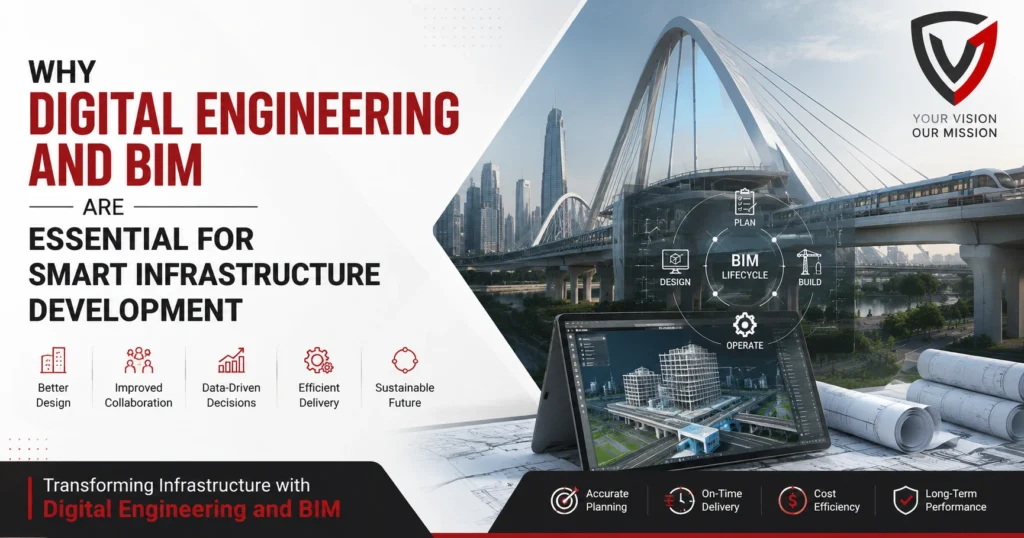
Introduction
The global construction and infrastructure sector is undergoing a profound digital transformation. As cities expand, populations grow, and the demand for efficient, resilient, and sustainable infrastructure intensifies, traditional project delivery methods are no longer sufficient. At the heart of this transformation lies Digital Engineering and BIM — a converging set of technologies, processes, and workflows that are redefining how infrastructure is planned, designed, built, and operated.
From large-scale transit networks and smart highways to energy-efficient buildings and integrated utility systems, Digital Engineering and BIM have become foundational tools for governments, developers, and engineering firms worldwide. They enable unprecedented levels of coordination, data-driven decision-making, and lifecycle performance management. Understanding why these technologies are not just useful but essential is critical for anyone involved in modern infrastructure delivery.
This article provides a comprehensive, expert-level exploration of Digital Engineering and BIM — covering their definitions, core workflows, project applications, implementation strategies, and future potential in driving smart infrastructure development across the globe.
What Is Digital Engineering and BIM?
Definitions and Core Concepts
Digital Engineering is the broad discipline of using digital tools, data, and processes throughout the full lifecycle of an engineering project. It encompasses everything from conceptual design and simulation to construction execution and long-term asset management. At its core, digital engineering replaces paper-based, fragmented workflows with integrated, data-rich environments that enable real-time collaboration and analysis.
Building Information Modeling Technology (BIM) is a specific, highly structured approach within digital engineering. BIM involves the creation and management of a shared digital representation of a built asset—capturing not just its geometry but also its physical properties, spatial relationships, material specifications, cost data, and performance characteristics. BIM is not merely a 3D modeling tool; it is a collaborative process that connects every stakeholder to a single source of truth throughout a project’s life.
Relationship Between Digital Engineering and BIM
While BIM is a component of digital engineering, the two are deeply interrelated. Digital engineering provides the overarching framework ——encompassingimulation, data management, automation, and systems integration—while BIM serves as the primary data backbone for built assets. Together, they form a powerful ecosystem that supports every phase of infrastructure development, from feasibility studies to decommissioning.
Key Components of the Digital Engineering Workflow
- Information and data management frameworks (Common Data Environments)
- 3D modeling and parametric design tools
- Clash detection and model coordination platforms
- Simulation and analysis software (structural, energy, hydraulic)
- Digital twin platforms for asset monitoring
- Cloud-based BIM collaboration tools
- Engineering design automation and AI-assisted systems
Why Smart Infrastructure Development Requires Digital Transformation
Growing Urbanization and Infrastructure Complexity
By 2050, nearly 70 percent of the global population will live in urban areas, according to United Nations projections. This unprecedented urbanization places enormous pressure on infrastructure systems — transportation, water, energy, communications, and public facilities. Managing these complex, interconnected systems requires capabilities that go far beyond what traditional engineering methods can provide.
Smart infrastructure development — infrastructure that is sensor-enabled, data-driven, and adaptable — demands a digital foundation. Digital engineering workflows and BIM provide the platform through which complex, multi-disciplinary infrastructure projects can be coordinated, analyzed, and delivered with the precision and efficiency that modern cities require.
Sustainability Goals and Environmental Accountability
Governments and organizations worldwide are committed to ambitious sustainability targets, including net-zero carbon goals and circular economy principles. Achieving these objectives in the built environment requires detailed analysis of energy consumption, carbon emissions, material use, and lifecycle environmental impact. BIM enables this analysis at the design stage, allowing engineers to optimize for sustainability before a single piece of infrastructure is built.
The Need for Real-Time Decision-Making
Infrastructure projects are complex, high-stakes undertakings involving dozens of stakeholders, thousands of decisions, and billions of dollars in investment. Traditional project management approaches — relying on periodic reports, siloed data, and manual coordination — are too slow and too error-prone for modern demands. Data-driven construction management, enabled by digital engineering platforms, delivers real-time insights that allow project teams to make informed decisions quickly and accurately.
The Role of Digital Engineering Workflow in Infrastructure Projects
The digital engineering workflow transforms every phase of an infrastructure project, creating continuity of data and process from inception to completion.
Planning and Feasibility
In the early stages, digital engineering tools support site analysis, geospatial data integration, environmental impact assessments, and multi-scenario planning. Decision-makers can evaluate options using accurate, data-rich models rather than rough estimates, improving the quality and speed of feasibility decisions.
Design and Analysis
During design, BIM enables multi-disciplinary teams to work concurrently in a shared model environment. Structural engineers, architects, MEP (mechanical, electrical, plumbing) specialists, and civil engineers all contribute to and draw from the same integrated dataset. This eliminates the coordination gaps and design inconsistencies that plague traditional workflows. Advanced simulation capabilities allow engineers to test structural performance, energy behavior, and construction sequences virtually before committing to final designs.
Construction Phase
On site, digital construction technology translates BIM models into actionable construction information. 4D BIM (time-linked models) allows project managers to visualize construction sequencing and identify scheduling conflicts before they occur on the ground. 5D BIM adds cost data, enabling dynamic cost tracking and forecasting throughout construction. Field teams can access BIM data directly via mobile devices, reducing reliance on paper drawings and minimizing errors.
Operations and Maintenance
After handover, BIM lifecycle management ensures that the data created during design and construction continues to add value. Facility managers receive a comprehensive digital record of the built asset—including installed equipment specifications, maintenance schedules, warranty information, and spatial data—enabling more efficient operations, planned maintenance, and better-informed capital renewal decisions.
How BIM Project Coordination Improves Project Success
Stakeholder Collaboration and Shared Data Environments
One of the most significant advantages of BIM project coordination is the elimination of information silos. Through a Common Data Environment (CDE), all project stakeholders—owners, designers, contractors, and subcontractors—access and contribute to the same authoritative model. This shared platform reduces miscommunication, accelerates approvals, and ensures that decisions are made with complete, current information.
Clash Detection and Risk Reduction
In traditionally delivered infrastructure projects, coordination clashes — where one discipline’s design physically conflicts with another’s — are frequently discovered on site, at enormous cost. BIM coordination tools automatically identify these clashes in the virtual model, allowing them to be resolved before construction begins. Industry research consistently shows that proactive clash detection through BIM saves significant time and money, with some studies reporting cost savings of 10 to 20 percent on affected elements.
Cost Reduction and Schedule Optimization
BIM project coordination directly improves cost and schedule performance by reducing rework, improving material quantity accuracy, and enabling more efficient procurement. Automated quantity take-offs from BIM models replace time-consuming manual measurements, improving the accuracy of cost estimates. Dynamic 4D scheduling tools help project managers sequence work more efficiently and respond to changes with minimal disruption.
Digital Construction Technology and the Future of Infrastructure
Artificial Intelligence and Machine Learning
AI integration within digital engineering platforms is rapidly advancing. Machine learning algorithms can analyze historical project data to predict cost overruns, schedule delays, and safety risks before they materialize. AI-assisted engineering design automation tools can generate and evaluate thousands of design options in minutes, identifying optimal solutions based on defined performance criteria.
Internet of Things and Real-Time Monitoring
The integration of IoT sensors with BIM models creates a living, real-time representation of infrastructure assets. Sensors embedded in bridges, tunnels, and buildings continuously feed data on structural behavior, environmental conditions, and system performance. This data, when overlaid on the BIM model, enables condition-based maintenance and early detection of potential failures.
Cloud Platforms and Remote Collaboration
Cloud-based BIM collaboration tools have fundamentally changed how geographically distributed project teams work together. Real-time model access, version control, and centralized issue tracking enable seamless coordination across time zones and disciplines, supporting both integrated project delivery and traditional delivery models.
Predictive Analytics and Automation
Predictive analytics, powered by digital engineering data, allows infrastructure owners to shift from reactive maintenance to proactive management. By analyzing patterns in sensor data, usage statistics, and historical maintenance records, predictive models identify when components are likely to fail—enabling targeted interventions before costly breakdowns occur.
BIM Implementation Strategies for Large-Scale Projects
Assessment and BIM Execution Planning
Successful BIM implementation begins with a thorough assessment of the organization’s current capabilities, technology stack, and project requirements. A BIM Execution Plan (BEP) defines the project’s BIM goals, data standards, workflows, responsibilities, and quality management processes. A robust BEP is the cornerstone of effective BIM project coordination and should be established before design work begins.
Team Training and Capability Development
Technology adoption without adequate training is a leading cause of BIM implementation failure. Organizations must invest in structured training programs that develop both technical BIM authoring skills and the broader process understanding required to use BIM effectively. Training should extend beyond designers to include project managers, construction teams, and client representatives.
Process Standardization and Information Management
Standardizing information requirements — defining what data needs to be captured, in what format, and at what stage — is essential for BIM to deliver value across the project lifecycle. Alignment with international standards, such as ISO 19650, provides a structured framework for information management that supports interoperability and data quality.
Long-Term Scalability
Organizations that invest in BIM implementation strategies with scalability in mind — building reusable model templates, standard libraries, and repeatable workflows — derive significantly greater returns over time. Scalable BIM environments support portfolio-level asset management and continuous improvement across projects.
Data-Driven Construction Management: Transforming Decision-Making
Data-driven construction management represents a fundamental shift in how infrastructure projects are planned, monitored, and controlled. By harnessing the rich data embedded in BIM models and supplemented by field sensors, drones, and IoT devices, project teams gain unprecedented visibility into project performance.
Real-Time Project Monitoring
Digital dashboards connected to BIM models and project management systems provide real-time updates on schedule progress, cost performance, resource utilization, and quality metrics. Project managers can identify deviations from plan early and take corrective action before minor issues become major problems.
Risk Management and Cost Forecasting
Advanced analytics tools, integrated with BIM data, support probabilistic risk modeling — quantifying the likelihood and impact of identified risks and informing contingency planning. Dynamic cost forecasting, updated automatically as design and construction progress, ensures that stakeholders always have an accurate picture of likely final costs.
Virtual Design and Construction (VDC) in Smart Infrastructure
What Is VDC?
Virtual Design and Construction (VDC) is an integrated approach that uses digital models — including BIM — alongside project management and process analysis tools to plan, design, and simulate construction activities before they occur on site. VDC extends BIM by incorporating production planning, logistics modeling, and team collaboration into the digital environment.
Benefits and Use Cases
VDC is particularly valuable for complex infrastructure projects such as underground transit systems, major highway interchanges, and large water treatment facilities—environments where construction sequencing is intricate and the cost of errors is high. By rehearsing construction activities digitally, VDC teams identify constructability issues, optimize work sequences, and improve site safety before physical construction begins.
Impact on Project Outcomes
Projects that use VDC consistently report improvements in schedule certainty, cost predictability, and safety performance. The ability to resolve coordination issues and optimize workflows in the virtual environment translates directly into smoother, more efficient construction execution.
Integrated Project Delivery and BIM Collaboration Tools
Integrated Project Delivery (IPD) is a project delivery model that aligns the interests of owners, designers, and constructors through shared risk and reward, collaborative decision-making, and early contractor involvement. BIM is the natural enabler of IPD, providing the shared information platform that makes genuine integration possible.
Shared Data Environments and Faster Approvals
BIM collaboration tools facilitate rapid, transparent communication between all project parties. Digital review workflows replace time-consuming paper-based processes, enabling faster regulatory approvals, permits, and client sign-offs. Visualization tools allow non-technical stakeholders to understand complex design proposals, improving engagement and accelerating decision-making.
Improved Stakeholder Engagement
BIM’s ability to produce photorealistic renderings, immersive virtual reality walkthroughs, and clear construction phase models dramatically improves stakeholder engagement. Community consultations, planning approvals, and investor presentations all benefit from the clarity and credibility that BIM visualization provides.
Engineering Design Automation and Construction Innovation Trends
Automated Design Generation and Parametric Modeling
Parametric modeling — where design elements are defined by rules and parameters rather than fixed geometry — enables rapid design iteration and automated compliance checking. Changes to one part of a parametric model automatically propagate throughout, maintaining design consistency and eliminating manual updating errors. Engineering design automation tools can apply optimization algorithms to parametric models, generating and evaluating design options at a scale and speed impossible with manual methods.
AI-Assisted Engineering and Emerging Trends
Generative design tools, powered by AI, are beginning to transform how engineers approach complex infrastructure challenges. By defining performance goals and constraints, engineers can instruct AI systems to generate novel design solutions that meet structural, environmental, and cost requirements — solutions that may not have been conceived through traditional approaches. Other construction innovation trends include robotic construction, 3D printing of structural elements, and augmented reality for site navigation and quality inspection.
Digital Twin Technology and Smart Infrastructure Development
What Is a Digital Twin?
A digital twin is a dynamic, real-time virtual replica of a physical asset or system, continuously updated with data from sensors and operational systems. Unlike a static BIM model, a digital twin evolves with the physical asset—capturing its current condition, operational status, and performance in real time. Digital twin technology represents the convergence of BIM, IoT, and advanced analytics into a single, living data environment.
Integration with BIM
BIM provides the foundational geometric and attribute data that populates the digital twin. As an asset moves from construction into operation, the BIM model transitions from a construction tool to the core of the digital twin framework. This continuity of data — from design through operations — is one of the most powerful aspects of mature digital engineering ecosystems.
Infrastructure Asset Monitoring and Predictive Maintenance
For infrastructure assets such as bridges, tunnels, water networks, and energy systems, digital twins enable condition monitoring at unprecedented granularity. Sensor arrays feed continuous structural, environmental, and operational data into the twin, enabling engineers to detect anomalies, model deterioration rates, and plan maintenance interventions based on actual asset condition rather than fixed schedules. This predictive maintenance approach significantly extends asset lifespan and reduces lifecycle costs.
BIM Lifecycle Management for Long-Term Infrastructure Performance
BIM lifecycle management extends the value of digital engineering investments beyond the construction phase into long-term asset ownership and operation. The principle is simple but powerful: the data created during design and construction should not be abandoned at handover — it should be maintained, enriched, and utilized throughout the asset’s entire service life.
Asset Management and Operational Efficiency
A well-maintained BIM asset model gives facility managers instant access to comprehensive information about every component of their infrastructure — from structural elements to mechanical systems. This enables faster fault diagnosis, more accurate maintenance planning, and better-informed capital renewal decisions. Integrated with computerized maintenance management systems (CMMS), BIM lifecycle management supports proactive, cost-effective operations.
Lifecycle Cost Optimization
By analyzing operational data alongside design specifications, lifecycle cost optimization tools can identify opportunities to reduce energy consumption, extend equipment life, and optimize maintenance cycles. Over a typical infrastructure asset life of 40 to 100 years, these optimizations can deliver savings that dwarf the initial investment in BIM implementation.
Importance of 3D Modeling in Construction
Enhanced Visualization and Communication
3D modeling in construction transforms how project information is communicated. Where traditional 2D drawings require significant technical expertise to interpret, 3D BIM models can be understood by a much wider range of stakeholders—from clients and community members to contractors and facility operators. This democratization of design information improves engagement, reduces misunderstandings, and accelerates decision-making at every stage of a project.
Improved Design Accuracy and Construction Sequencing
3D models eliminate the ambiguities inherent in 2D documentation by representing every element of an infrastructure project in its true spatial context. This reduces design errors, improves buildability, and enables detailed construction sequencing planning — including the visualization of crane movements, temporary works, and material delivery logistics. The result is a more efficient, predictable construction process with fewer surprises.
Key Benefits of Digital Engineering and BIM: Summary
Key Benefits at a Glance
- Reduced project cost through early clash detection and accurate quantity take-offs
- Improved schedule certainty with 4D construction sequencing and simulation
- Enhanced collaboration across all project stakeholders via shared data environments
- Better design quality through integrated multi-disciplinary coordination
- Lower operational costs enabled by data-driven maintenance and asset management
- Stronger sustainability outcomes through integrated environmental analysis
- Greater infrastructure resilience through digital twin monitoring and predictive maintenance
- Faster regulatory approvals supported by clear, comprehensive BIM documentation
- Improved safety through virtual construction planning and hazard identification
- Scalable knowledge management through reusable BIM templates and data standards
Traditional Infrastructure Development vs Digital Engineering and BIM
| Aspect | Traditional Development | Digital Engineering & BIM |
| Design Process | 2D drawings, manual revisions | 3D parametric models, automated updates |
| Collaboration | Siloed teams, slow communication | Real-time shared data environments |
| Clash Detection | Found on site (costly) | Detected virtually before construction |
| Cost Estimation | Manual take-offs, prone to error | Automated quantity extraction from models |
| Project Visibility | Limited stakeholder insight | Full lifecycle visualization |
| Risk Management | Reactive after issues arise | Predictive analytics and early warning |
| Sustainability | Hard to assess environmental impact | Integrated energy/carbon analysis |
| Asset Management | Paper-based records | Digital twin and live asset data |
| Rework Rate | High (industry avg ~9% of cost) | Significantly reduced through virtual testing |
The Growing Demand for BIM Services in Dubai
Digital Transformation in Dubai’s Construction Sector
Dubai has positioned itself as a global leader in smart city development, with a construction sector that consistently embraces cutting-edge technology. The emirate’s Vision 2040 Urban Master Plan, its ambitious sustainability commitments, and a pipeline of world-class infrastructure projects have created significant and growing demand for professional BIM service in Dubai. Government mandates requiring BIM for public sector projects have accelerated adoption across both the public and private construction sectors.
Smart City Initiatives and Infrastructure Modernization
Dubai’s smart city agenda encompasses intelligent transportation systems, smart energy grids, integrated building management, and digitally connected public infrastructure. BIM is the essential enabling technology for each of these initiatives—providing the data foundation for smart systems integration, lifecycle management, and performance optimization. Infrastructure projects including metro expansions, airport developments, and major mixed-use developments are increasingly delivered using advanced BIM workflows.
Benefits of Professional BIM Services in Dubai
Professional BIM service providers in Dubai offer the expertise, technology, and process knowledge to help developers, contractors, and government agencies implement BIM effectively across complex, large-scale projects. From BIM Execution Plan development and model authoring to coordination, clash detection, and lifecycle handover management, specialized BIM service providers deliver measurable improvements in project outcomes—making them an essential partner for organizations seeking to maximize the value of their digital engineering investments.
Challenges and Solutions in Adopting Digital Engineering and BIM
Technology Barriers and Integration Challenges
Despite the clear benefits, organizations often face significant barriers when adopting digital engineering and BIM. Legacy software systems, lack of interoperability between tools, and resistance to workflow change can slow adoption. Addressing these barriers requires a phased implementation approach — beginning with foundational BIM capabilities and progressively introducing more advanced tools as organizational maturity grows.
Training Gaps and Change Management
The human dimension of BIM adoption is frequently underestimated. Technical tools are only as effective as the people using them. Comprehensive training programs, supported by clear change management strategies, are essential for building the organizational capability and cultural commitment needed to sustain digital engineering transformation. Leadership engagement and visible executive sponsorship are critical success factors.
Data Management and Information Quality
BIM’s value depends entirely on the quality and completeness of the information it contains. Poor data management practices—inconsistent naming conventions, incomplete attribute data, uncontrolled model revisions—undermine the benefits of BIM and create coordination failures. Implementing robust information management frameworks, aligned with standards such as ISO 19650, establishes the data governance discipline needed to realize BIM’s full potential.
Future Outlook: Digital Engineering and BIM in Smart Cities
Emerging Innovations and AI-Powered Infrastructure
The future of digital engineering and BIM is defined by deepening integration between technologies. AI will increasingly automate design generation, coordination checking, and performance analysis. Digital twins will evolve from monitoring tools into active management systems — capable of autonomously adjusting infrastructure operations in response to changing conditions. Extended reality (XR) technologies — including augmented reality and virtual reality — will become standard tools for design review, construction inspection, and operator training.
Sustainability and Connected Ecosystems
As sustainability requirements intensify, digital engineering will play an ever-more-central role in enabling infrastructure that is not just efficient but genuinely regenerative. BIM-integrated carbon analysis, circular economy material tracking, and whole-life environmental assessment will become standard practice. Smart infrastructure ecosystems — where buildings, transport networks, utilities, and public spaces share data and coordinate operations — will depend on mature digital engineering foundations to function effectively.
Conclusion
Digital Engineering and BIM have fundamentally transformed what is possible in infrastructure development. By creating an integrated, data-rich digital environment that spans the full lifecycle of an asset—from initial concept through decades of operation—these technologies enable infrastructure that is smarter, more sustainable, more efficient, and more resilient than anything achievable through traditional methods.
For construction professionals, infrastructure developers, government agencies, and project managers, the question is no longer whether to adopt Digital Engineering and BIM, but how to implement them most effectively to maximize value. The evidence from projects worldwide is unequivocal: organizations that embrace digital engineering workflows, invest in BIM project coordination, and build the organizational capability to sustain digital transformation consistently outperform their traditionally minded peers—delivering projects on time, within budget, and with superior long-term performance outcomes.
Frequently Asked Questions
1. What is the difference between Digital Engineering and BIM?
Digital Engineering is the broader discipline of using digital tools, data, and processes across the entire lifecycle of engineering projects — encompassing simulation, data management, automation, and systems integration. BIM (Building Information Modeling Technology) is a specific methodology within digital engineering focused on creating and managing a shared digital representation of a built asset. BIM is a core component of a mature digital engineering ecosystem, providing the foundational data model for built infrastructure.
2. How does BIM support smart infrastructure development?
BIM supports smart infrastructure development by providing the data foundation for integrated design coordination, lifecycle asset management, and digital twin creation. It enables multi-disciplinary teams to collaborate in real time, supports sustainability analysis, facilitates automated quality checking, and creates the structured data environment that smart city systems — including IoT sensor networks and AI management platforms — require to function effectively.
3. What are the key benefits of Digital Engineering and BIM in construction?
The key benefits include significant reductions in project cost and schedule through clash detection and 4D scheduling; improved design quality through integrated multi-disciplinary coordination; enhanced stakeholder communication through 3D visualization; more accurate cost forecasting through automated quantity extraction; better lifecycle asset management through BIM data continuity; and improved sustainability outcomes through integrated environmental analysis. Projects using BIM consistently demonstrate lower rework rates and higher client satisfaction than those using traditional methods.
4. How does digital twin technology work with BIM?
A digital twin begins with the BIM model as its geometric and attribute data foundation. As infrastructure moves from construction into operation, IoT sensors embedded in the physical asset feed real-time performance, condition, and environmental data back to the digital twin platform. This creates a continuously updated virtual replica of the physical asset, enabling condition monitoring, predictive maintenance, operational optimization, and scenario analysis throughout the asset’s service life.
5. Why is BIM project coordination important?
BIM project coordination is important because it eliminates the costly coordination failures — design clashes, information gaps, and communication breakdowns — that plague traditionally delivered infrastructure projects. By providing all project stakeholders with access to a single, authoritative model in a shared data environment, BIM coordination ensures that design conflicts are resolved virtually before construction begins, that all team members work from current information, and that project changes are managed in a controlled, transparent manner.
6. Why are BIM services becoming popular in Dubai?
BIM services are becoming increasingly popular in Dubai due to a combination of government mandates, ambitious smart city development programs, and a highly competitive construction market that rewards efficiency and quality. Dubai’s Vision 2040 Urban Master Plan and its commitment to becoming a global smart city hub have driven significant public and private investment in digital infrastructure delivery. Professional BIM service providers help organizations navigate the technical and process complexity of BIM adoption, delivering measurable improvements in project outcomes across Dubai’s world-class infrastructure pipeline.