
Benefits of outsourcing BIM model auditing in UAE construction industry
Benefits of outsourcing BIM model auditing in UAE construction industry
Introduction
The UAE construction industry has emerged as one of the most technologically advanced in the world. From the towering skylines of Dubai to the ambitious infrastructure programs in Abu Dhabi and beyond, Building Information Modeling (BIM) has become a cornerstone of modern project delivery across the region.
As BIM adoption accelerates, so does the demand for rigorous model quality control. Poorly executed BIM models lead to costly clashes, design errors, delayed approvals, and regulatory non-compliance — all of which erode project margins and timelines. This is why professional BIM model auditing services in Dubai UAE have become an indispensable component of successful construction project delivery.
For construction companies, developers, and engineering firms operating in the UAE, the question is no longer whether to audit BIM models but whether to build that capability in-house or outsource it to specialist providers. This article explores the compelling case for outsourcing BIM model auditing and how it delivers measurable value across the project lifecycle.
What is BIM Model Auditing?
BIM model auditing is the systematic review and validation of a BIM model to ensure it meets defined standards, project requirements, and quality benchmarks. It is a critical quality assurance process that occurs at key project milestones to identify errors, inconsistencies, and compliance gaps before they escalate into costly construction problems.
Key audit areas typically include:
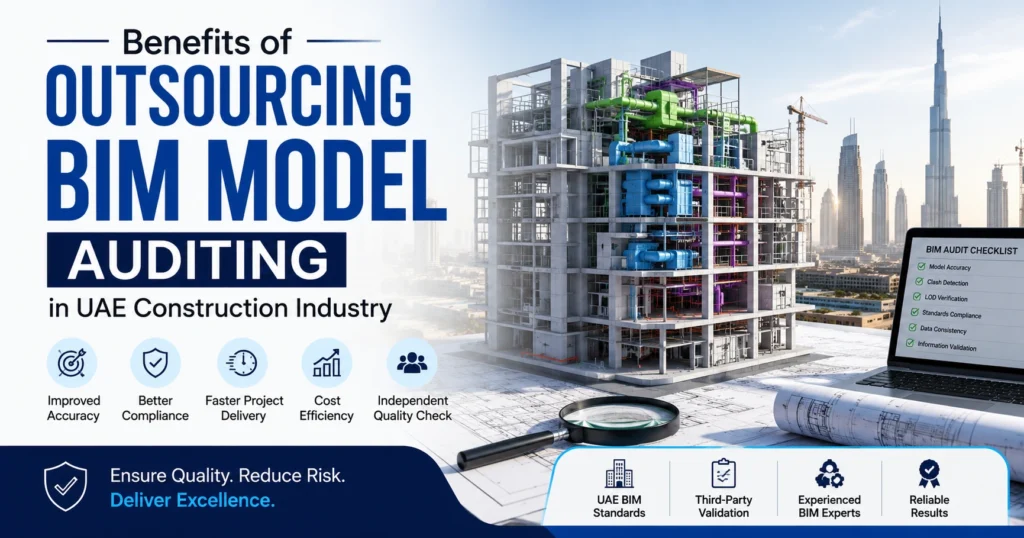
- Model Accuracy — Verifying that geometry, dimensions, and spatial relationships are correct and consistent with design intent.
- Data Consistency — Ensuring all object properties, parameters, and metadata are complete and correctly assigned.
- Clash Detection Review — Identifying hard clashes, soft clashes, and workflow clashes between architectural, structural, and MEP models.
- Level of Development (LOD) Verification — Confirming that model elements meet the required LOD for each project phase.
- Standards Compliance— Checking adherence to relevant BIM standards, including ISO 19650, UAE BIM Mandate requirements, and client-specific BIM Execution Plans (BEPs).
- Information Validation — Auditing data-rich elements to ensure accurate information for facilities management and downstream use.
For large-scale UAE projects — where multiple consultants, contractors, and subcontractors contribute to federated models — auditing is not optional. It is a fundamental risk management tool that protects project quality, schedule, and budget.
Why BIM Model Auditing Services in Dubai UAE Matter for Construction Projects
The UAE construction sector is characterized by rapid infrastructure growth, complex multidisciplinary projects, and increasingly stringent government BIM requirements. Several major municipalities and authorities — including Dubai Municipality, Abu Dhabi’s Department of Urban Planning and Municipalities, and various free zone authorities — have introduced BIM mandates for projects above defined thresholds.
These regulatory requirements create a direct need for structured model auditing. Beyond compliance, the sheer complexity of UAE mega-projects—airports, mixed-use developments, healthcare facilities, and smart city infrastructure—demands rigorous coordination between architecture, structure, civil, and MEP disciplines. Without systematic auditing, errors compound across disciplines, leading to expensive rework during construction.
Furthermore, developers and owners in the UAE increasingly recognize BIM’s value beyond design and construction—for asset management, facilities operations, and digital twin applications. This long-term perspective places even greater importance on model accuracy and data integrity from the earliest project stages.
Key Benefits of Outsourcing BIM Model Auditing
1. Access to Specialised BIM Expertise
Outsourcing BIM model auditing gives construction firms immediate access to experienced professionals who specialize exclusively in model quality control. These experts possess deep knowledge of international standards—including ISO 19650, COBie, and IFC protocols—alongside UAE-specific regulatory requirements.
Specialist auditors bring a level of proficiency that is difficult to replicate with generalist in-house teams. They are familiar with common modeling errors across different software platforms—Autodesk Revit, Bentley, and ArchiCAD—and can identify issues that less experienced reviewers might miss. The result is a higher standard of quality control that directly improves project outcomes.
2. Improved Model Accuracy and Quality
Professional auditors employ structured methodologies and industry-standard audit tools to detect errors and inconsistencies that internal teams may overlook due to familiarity bias. By systematically reviewing every model element against project specifications and BIM standards, outsourced auditors dramatically improve the overall reliability of BIM deliverables.
Improved model accuracy reduces the frequency and cost of design changes during construction, minimizes material waste, and supports more accurate quantity surveying and cost planning—all critical factors for project profitability in the UAE’s competitive construction market.
3. Cost Savings and Resource Optimisation
Building an in-house BIM auditing capability requires significant investment in recruitment, software licences, training, and ongoing professional development. For many construction firms, particularly small and mid-sized businesses, this overhead is difficult to justify given the variable demand for auditing services across project lifecycles.
Outsourcing converts fixed costs into variable ones, allowing companies to engage specialist auditors precisely when needed. This operational flexibility delivers measurable cost savings while ensuring access to expert-level quality control — without the burden of maintaining a full-time auditing function.
4. Faster Project Delivery
Early identification of modeling issues prevents them from cascading into construction-phase problems. Outsourced auditing teams work efficiently within structured workflows, providing rapid turnaround on audit reports that enable design teams to address corrections without disrupting project schedules.
In fast-paced UAE construction environments—where project programs are often aggressive and delays incur substantial penalties—the speed and efficiency of professional BIM auditing directly support on-time delivery.
5. Better Compliance with UAE Regulations and Client Requirements
Specialist BIM auditors understand the regulatory landscape governing construction in the UAE and ensure models comply with both government mandates and client-specific requirements. This includes verifying adherence to BIM Execution Plans, confirming that models meet submission standards required by approval authorities, and ensuring information management aligns with asset handover requirements.
Proactive compliance management reduces the risk of costly resubmissions and approval delays — a significant advantage on projects where regulatory approvals sit on the critical path.
6. Independent and Objective Quality Assessment
One of the most valuable aspects of outsourced auditing is the independence it provides. Internal reviewers, however skilled, are often subject to organizational pressures and familiarity with their own work that can compromise objectivity. A third-party auditor brings an unbiased perspective to model review, providing findings that stakeholders—developers, owners, and approval authorities—can trust.
This independent assurance strengthens confidence among all project stakeholders and supports more transparent reporting on BIM model quality throughout the project lifecycle.
7. Reduced Construction Risks
Early identification of design conflicts, coordination clashes, and data gaps significantly reduces the risk of costly site surprises. Research across the construction industry consistently demonstrates that the cost of resolving issues in BIM is a fraction of the cost of resolving the same issues on site.
By systematically auditing models before construction begins, outsourced auditing services act as a proactive risk management mechanism that protects project contingency budgets and reduces the likelihood of contentious disputes between contractors and clients.
8. Enhanced Collaboration Across Disciplines
Audit findings provide a neutral, evidence-based foundation for collaboration between architectural, structural, and MEP teams. When issues are surfaced objectively—with clear documentation of clashes and data inconsistencies—discipline leaders can address problems constructively rather than defensively.
This improved communication across disciplines reduces the frequency of coordination meetings focused on blame attribution and instead directs project teams towards collaborative problem-solving—ultimately reducing delays and improving team morale.
9. Scalability for Large and Complex Projects
Outsourced BIM auditing providers can scale their services to match project complexity and volume. Whether a firm is managing a single major development or a portfolio of concurrent projects, specialist auditors can adjust resource allocation accordingly—ensuring consistent quality standards are maintained regardless of project scale.
This scalability is particularly valuable for UAE construction firms managing multiple projects across different emirates and sectors, where internal capacity constraints would otherwise create bottlenecks in quality assurance workflows.
10. Support for Digital Construction Transformation
As the UAE advances its digital construction agenda — aligned with national visions for smart cities and sustainable infrastructure — the quality of BIM implementation becomes increasingly strategic. Outsourced auditing partners do more than check model quality; they help organizations build stronger BIM governance frameworks, improve internal standards, and maximize return on BIM technology investments.
By working alongside specialist auditors, in-house BIM teams also develop their own capabilities over time—creating a virtuous cycle of continuous improvement in digital construction practice.
Role of BIM Component Creation in Successful BIM Auditing
Model audit outcomes are directly influenced by the quality of the BIM components—or objects—used to build the model. Poorly constructed components introduce inaccuracies, missing parameters, and non-standard geometry that auditors must identify and flag, adding time and cost to the audit process.
This is where professional BIM component creation services in Dubai UAE play a critical supporting role. Standardized, well-structured BIM components—built to project specifications and LOD requirements—form the foundation of an auditable, high-quality model. When components are consistent, accurate, and data-rich from the outset, auditors can focus on coordination and compliance rather than fundamental object quality issues.
Organizations that invest in professional component libraries reduce audit correction cycles, accelerate model approval processes, and ensure better information quality for downstream uses—from quantity surveying and cost planning through to facilities management and digital twin applications.
Common Challenges Solved by Outsourced BIM Auditing
Outsourced BIM auditing addresses a range of challenges that consistently affect project quality in UAE construction:
- Inconsistent Modeling Practices — When multiple teams model to different standards, federated models become unreliable. Auditing establishes a consistent quality baseline across all contributors.
- Missing Project Data — Incomplete object parameters undermine downstream BIM uses. Auditors identify and document data gaps for correction before models are issued for construction.
- Non-Compliance with Standards — Without structured review, models frequently fail to meet BIM Execution Plan requirements or regulatory standards. Auditing ensures compliance before submission to approval authorities.
- Coordination Issues — Unresolved clashes between disciplines cause expensive on-site conflicts. Systematic clash detection review surfaces and documents these issues for resolution.
- Poor Model Documentation — Inadequate audit trails and documentation weaken stakeholder confidence. Professional auditing provides structured reporting that supports transparent project governance.
How to Select the Right BIM Model Auditing Partner in UAE
Choosing the right BIM auditing partner is a strategic decision that directly affects project quality and risk exposure. When evaluating potential providers offering BIM model auditing services in UAE, consider the following criteria:
- UAE Project Experience — Prioritise auditors with a proven track record on UAE projects. Knowledge of local regulatory requirements, municipality standards, and authority submission processes is essential.
- Technical Expertise — Confirm that auditors are proficient in the BIM software platforms used on your projects and experienced with the full range of audit disciplines—architecture, structure, MEP, and civil.
- Knowledge of BIM Standards — Verify familiarity with ISO 19650, BS EN standards, COBie, IFC, and UAE-specific BIM mandates.
- Demonstrated Track Record — Request case studies or references from comparable UAE projects. Evidence of successfully resolved audits on complex, large-scale projects is a strong indicator of capability.
- Quality Assurance Processes — Understand the auditor’s methodology, tools, and reporting standards. A structured, documented process is essential for consistent, reliable results.
- Communication and Reporting — Evaluate the clarity and usability of audit reports. Findings should be actionable, clearly prioritized, and communicated in a format that project teams can act upon efficiently.
Conclusion
As BIM becomes the standard language of UAE construction, the quality of model data and coordination has never been more important. Outsourcing BIM model auditing delivers a powerful combination of specialist expertise, objective assessment, cost efficiency, and regulatory compliance—benefits that are increasingly difficult to replicate with in-house resources alone.
From faster project delivery and reduced construction risk to enhanced stakeholder confidence and stronger digital transformation outcomes, the advantages are clear and measurable. Construction companies, developers, and engineering firms that adopt professional BIM model auditing services in Dubai UAE position themselves for better project outcomes, stronger compliance, and a competitive advantage in one of the world’s most dynamic construction markets.
The time to invest in professional BIM model auditing is now — before project issues become construction problems, and before compliance gaps become approval delays. With the right outsourced partner, UAE construction firms can unlock the full value of their BIM investments and deliver projects with greater confidence, quality, and predictability.
Frequently Asked Questions
1. How to choose a reliable BIM model auditing company in Dubai?
Selecting a reliable BIM model auditing company in Dubai requires careful evaluation across several dimensions. First, assess their experience with UAE projects—local regulatory knowledge and familiarity with authority submission requirements are non-negotiable. Look for professional certifications such as ISO 19650 accreditation and verify that their auditors hold relevant BIM qualifications.
Review their project portfolio for evidence of successful audits on comparable projects — mega-developments, mixed-use schemes, healthcare facilities, or infrastructure projects similar to your own. Evaluate their quality assurance processes, including the tools they use for clash detection, data validation, and compliance checking. Finally, assess their reporting standards—audit reports should be clear, actionable, and structured to support efficient correction workflows.
2. What are the benefits of third-party BIM model validation for construction projects in the UAE?
Third-party BIM model validation provides independent, unbiased review of model quality that internal teams cannot replicate. Key benefits include reduced project risk through early identification of coordination clashes and data errors; improved compliance with UAE regulatory requirements and client BIM standards; enhanced stakeholder confidence through transparent, objective quality reporting; and better project outcomes through higher model accuracy and reduced construction-phase rework.
Independent validation also strengthens contractor-client relationships by providing a neutral quality assurance framework that both parties can trust—reducing the potential for disputes over model quality and information accuracy.
3. What is the cost estimate for BIM model auditing services in Dubai, UAE?
The cost of BIM model auditing services in Dubai UAE varies based on several factors. Project size is a primary determinant — larger, more complex models require greater audit effort and thus higher fees. Model complexity, including the number of disciplines, level of detail, and federated model structure, also significantly influences pricing.
The Level of Development (LOD) required affects audit scope, as higher LODs require more detailed verification of model elements and data attributes. The audit scope itself — whether it encompasses a single discipline or a full multi-discipline federated model — is another major pricing variable. Custom requirements, such as specialized compliance checks or expedited delivery, may attract premium fees. Most reputable providers offer fixed-price audits for defined scopes or time-and-materials arrangements for more complex, evolving requirements.
4. What is the typical process for a BIM model audit?
A professional BIM model audit typically follows a structured, multi-stage process. It begins with model collection and documentation review—auditors receive the current model files along with the BIM Execution Plan, project standards, and relevant specifications. The standards review stage establishes the compliance framework against which the model will be assessed.
Data verification follows, with auditors systematically checking object parameters, metadata completeness, and information accuracy. Clash and coordination checks identify hard clashes, soft clashes, and workflow conflicts across disciplines. A formal compliance assessment evaluates the model against BIM standards and project requirements, resulting in a comprehensive audit report. This report documents all findings, prioritises issues by severity, and provides corrective action recommendations for the design team to resolve before the next project milestone.
5. How does BIM model auditing improve project compliance in Dubai?
BIM model auditing improves project compliance in Dubai through systematic verification of models against the BIM Execution Plan, authority submission requirements, and relevant national and international standards. Auditors confirm that models adhere to the information delivery requirements specified in the BEP — including LOD milestones, naming conventions, and data schema requirements.
By identifying and documenting compliance gaps before models are submitted to approval authorities, auditing reduces the risk of costly resubmissions and approval delays. Consistently high model quality and thorough documentation improve the efficiency of approval processes with Dubai Municipality and other relevant authorities. Over time, a track record of compliant BIM submissions builds trust with regulatory bodies and strengthens a firm’s reputation for professional BIM delivery in the Dubai market.
Vee7 works with sub-contractors and specialist contractors across UAE and Saudi Arabia on BIM delivery that is structured to protect commercial position—not just meet submission requirements. If your BIM setup has no variation risk process behind it, that is the right conversation to have before your next package.