
Mechanical Drafting Services in UAE for Accurate 2D and 3D CAD Designs
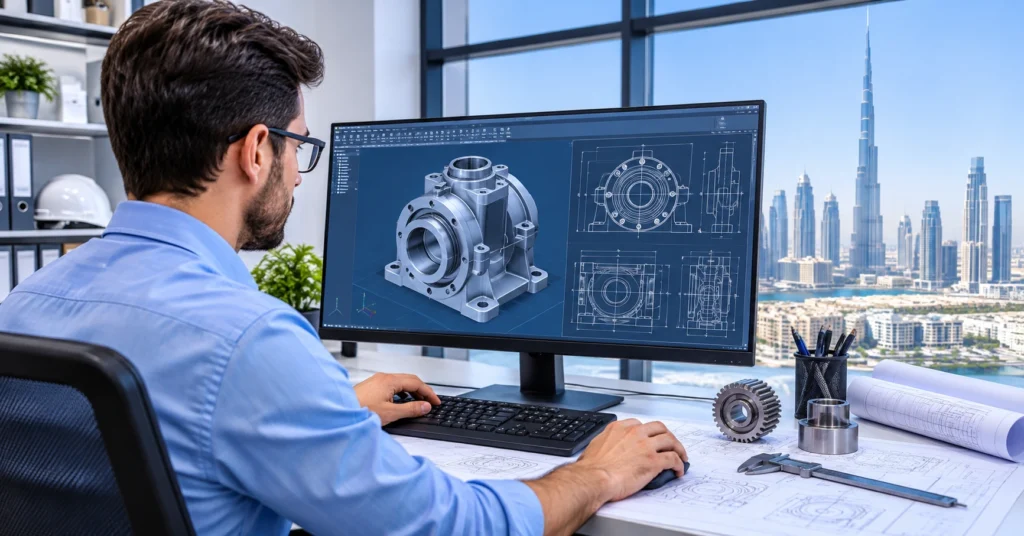
Every machine, fabricated frame, piping skid or HVAC plant room begins as an idea and becomes a buildable product only when it is described in precise technical drawings. Mechanical drafting services in UAE turn engineering concepts, sketches, calculations, and specifications into dimensioned, standards-compliant CAD documents that manufacturers, fabricators, and installers can work from without guesswork.
The UAE has a broad base of industrial and infrastructure activity, including manufacturing zones, oil and gas facilities, large construction programs, logistics hubs and a steadily developing fabrication sector. Projects in these areas involve multiple disciplines, tight schedules, and contractors who may sit in different emirates or even different countries. In that setting, clear and accurate CAD documentation is not an administrative extra. It is the shared reference that keeps design intent, procurement, workshop production, and site installation aligned.
This page explains what mechanical drafting involves, the services it covers, how the drafting process works, which software is commonly used, and what to look for when selecting a partner. It is written for engineering firms, manufacturers, contractors and product developers who want to understand the discipline properly before they commit a project to an external team. For businesses that are ready to move forward, the closing section outlines how to start a conversation about project requirements.
What Are Mechanical Drafting Services?
Mechanical drafting services cover the preparation of technical drawings and CAD models that describe mechanical components, assemblies, equipment and systems. A mechanical drafter takes information from engineers, designers or clients, such as concept sketches, performance requirements, vendor data, markups and reference drawings, and produces documents that define exactly what is to be made or installed. Those documents typically show geometry, dimensions, tolerances, materials, surface finishes, welding and fastening details, bills of materials and revision history.
It helps to separate two closely related activities. Mechanical design is the engineering decision-making: selecting mechanisms, sizing members, choosing materials, checking loads and deciding how parts fit together. Mechanical drafting is the translation of those decisions into formal drawings and models. In practice the two overlap. A drafter often resolves small geometric conflicts, proposes practical detailing options and flags inconsistencies, while a designer or engineer reviews and approves the result. Many clients therefore look for mechanical design services in UAE and drafting support from the same team, particularly when a project moves quickly from concept to production.
The value of accurate drawings is easy to underestimate until something goes wrong. An undimensioned feature, a missing tolerance or an outdated revision can lead to rejected parts, rework at the fabrication shop or clashes discovered only on site. Well-prepared drawings reduce those risks by removing ambiguity. They give procurement teams a reliable basis for quotations, give workshops a clear manufacturing instruction and give project managers a controlled record of what was approved and when.
Comprehensive Mechanical CAD Drafting Services in UAE
Projects differ in size and maturity, so the scope of mechanical CAD drafting services UAE clients request varies widely. Some need a single bracket detailed for machining. Others need hundreds of fabrication drawings for a structure or equipment package. The services below represent the main categories of work.
2D Mechanical Drafting Services
Two-dimensional drawings remain the standard instrument for communicating manufacturing and installation information. Mechanical 2D drafting services UAE typically include plan, elevation, section, and detail views, dimensioning; tolerancing, notes, title blocks and parts lists. They are used for general arrangement drawings, equipment layouts, piping and ducting arrangements, machine part drawings, and installation details.
2D drawings are valuable because workshops, inspectors and site teams are used to reading them and because they can be printed, marked up and archived easily. For clients with legacy products or established drawing systems, 2D documentation is often the most practical way to keep records consistent.
3D Mechanical CAD Modelling
Mechanical 3D drafting services UAE focus on building solid or surface models of parts and assemblies. A 3D model carries geometry in a form that can be rotated, sectioned, measured and checked for interference. It also provides the starting point for downstream tasks such as generating 2D drawings, preparing data for CNC machining, laser cutting or 3D printing, creating exploded views for manuals and supporting engineering analysis.
Modelling is especially useful for complex equipment where spatial relationships are hard to judge from flat views. Detecting a collision between a motor, a guard and a support frame in the model is far cheaper than finding it during assembly.
Mechanical Assembly Drawings
Assembly drawings show how individual components fit together to form a unit. They identify each part with balloon numbers, list quantities in a bill of materials, and indicate the order or method of assembly where needed. For manufacturers, they guide workshop assembly and quality checks. For maintenance teams, they serve as a reference when a machine must be dismantled or a spare part identified.
Mechanical Fabrication and Shop Drawings
Fabrication detailing is among the most common requests for mechanical shop drawing services UAE. Shop drawings are production-level documents that convert design or approved-for-construction drawings into the exact information a workshop needs: cut lengths, plate profiles, hole positions, weld symbols, bevel preparations, bolting details, surface treatment notes and marking. They are widely used for steel and metal fabrication, skids, platforms, supports, ductwork, tanks, pipe spools, and equipment frames.
Good shop drawings account for how things are actually made. A drafter who understands fabrication practice will consider material availability, welding access, handling limits and transport constraints, which makes the output easier to build and reduces queries from the workshop floor.
Mechanical Component Detailing
Component detailing produces fully dimensioned drawings of individual parts for machining, casting, sheet-metal forming, or molding. These drawings define the geometry together with tolerances, fits, material grades, heat treatment, and finish requirements. Where relevant, geometric dimensioning and tolerancing (GD&T) is applied so that functional relationships between features are controlled clearly. Accurate component drawings allow parts to be sourced from different suppliers and still fit together.
Mechanical Design and Engineering Drawings
Beyond pure drafting, many projects need support at the design-development stage: layouts, concept drawings, equipment arrangements, tender drawings and engineering drawings prepared from calculations or specifications. This is where the mechanical engineering drafting work in the UAE merges with design assistance. The deliverables are usually reviewed by the client’s engineer, so clear communication of assumptions and open points is as important as the drawings themselves.
CAD Conversion and Drawing Modification
Businesses often hold older information in paper drawings, scanned images, PDFs or obsolete file formats. CAD conversion recreates these documents as editable, scaled digital drawings or models. Drawing modification covers the updating of existing files after design changes, as-built surveys or site revisions. Together these services help companies maintain a usable drawing archive, reverse engineer parts that no longer have documentation, and prepare accurate records for upgrades or refurbishment.
Importance of Accurate 2D and 3D CAD Designs in Mechanical Engineering
Accuracy in CAD work affects every stage that follows it. The main benefits can be grouped as follows.
- Dimensional precision: Correct dimensions and tolerances ensure that parts made by different suppliers or workshops will assemble as intended, and that the manufacturing process can hold the required fits.
- Improved visualisation: 3D models let engineers, clients and site teams understand a design before anything is produced. Stakeholders who are not trained to read drawings can still review a model and give meaningful feedback.
- Reduced engineering errors: Interference checks, consistent dimensioning and structured drawing reviews catch problems at the desk, where correction costs little compared with correction in the workshop or on site.
- Better team communication: A single set of controlled drawings gives designers, procurement staff, fabricators and installers the same information, which lowers the number of clarification requests and informal changes.
- Manufacturing and fabrication efficiency: Clear part drawings, nesting-ready profiles and complete bills of materials shorten planning time and reduce material waste.
- Documentation and coordination: Revision control, drawing registers and consistent title blocks make audits, approvals and handovers more orderly.
Industries That Require Mechanical Drafting Services in UAE
Mechanical drawings are needed wherever physical equipment is designed, produced or installed. The following sectors commonly rely on external drafting capacity.
Manufacturing and industrial production: Factories need drawings for production lines, tooling, jigs, fixtures, guarding, and process equipment, along with updates whenever lines are modified or expanded.
Oil and gas: Facilities in this sector involve skids, pressure-related equipment supports, pipe racks, platforms, access structures, and associated mechanical packages. Drawings must typically follow client and project specifications and be traceable through formal revision control.
Construction and infrastructure: Building and infrastructure projects use mechanical drawings for plant rooms, lifting equipment, supports, brackets, steel connections and builders’ work coordination.
HVAC and MEP engineering: Ducting, chilled water pipework, equipment layouts and supports need coordinated drawings so that services fit within limited ceiling and shaft space. Shop drawings in this area are used for fabrication and installation.
Automotive and transportation: Vehicle modification, body-building, trailers, special-purpose vehicles and transport equipment all need part and assembly drawings for fabrication and fitting.
Industrial machinery and equipment: Manufacturers of pumps, conveyors, packaging machines, material handling systems and similar equipment require detailed component and assembly documentation for production and servicing.
Fabrication and metalworking: Steel, stainless steel and aluminium fabricators depend on shop drawings, cutting lists and welding details to run their workshops efficiently.
Product design and development: Start-ups and established product teams use 3D CAD to develop prototypes, check fit and function, and prepare documentation for production.
Mechanical Drafting Process: From Initial Requirements to Final CAD Drawings
A structured workflow keeps drafting consistent and traceable. While details vary between organisations and projects, the sequence below reflects common practice.
1. Understanding Project Requirements
The process begins with clarifying scope: what is to be drawn, which standards apply, which file formats are required, how many drawings are expected and what the delivery timeline looks like. Early alignment on drawing sheet sizes, units, layer or model conventions and numbering systems prevents rework later.
2. Reviewing Technical Specifications and Reference Documents
The drafting team studies the supplied sketches, markups, vendor catalogues, specifications, existing drawings and applicable standards. Any gaps or contradictions are raised with the client at this stage rather than resolved by assumption.
3. Preparing Initial 2D CAD Drawings
Layouts, views and key dimensions are set up in 2D to establish the overall arrangement. For many projects these first drawings are shared with the client for early review of general configuration.
4. Developing 3D Mechanical Models
Where the project calls for it, parts and assemblies are modelled in 3D. The model helps verify fit, clearances and motion, and it often becomes the source for the final detailed drawings and any manufacturing data.
5. Checking Dimensions and Technical Accuracy
Dimensions, tolerances, material notes, weld details and bills of materials are checked against the source information and drawing standards. A drafter checking their own work is useful, but an independent check by a second person is more reliable.
6. Reviewing and Coordinating Drawings
Drawings are reviewed with the client’s engineers or other disciplines. Comments are recorded, changes are made and revision numbers are updated. Coordination is particularly important on multi-discipline projects where mechanical drawings must align with structural, electrical or architectural information.
7. Delivering Final CAD Files and Documentation
The final package may include native CAD files, DWG or DXF files, PDFs, STEP or IGES models, bills of materials and a drawing register, depending on what was agreed. A clear handover with consistent file naming helps the client’s team use the material without confusion.
Software Used for Professional Mechanical CAD Drafting Services
Different tools suit different tasks, and a drafting provider will usually specialise in a subset rather than every package. The software below is widely used in mechanical work.
- AutoCAD: A long-established platform for 2D drafting, widely used for layouts, shop drawings and general documentation. DWG is a common exchange format across industries.
- SolidWorks: A parametric 3D modelling system popular for machine design, product development and fabricated assemblies, with built-in tools for drawings and bills of materials.
- Autodesk Inventor: A parametric 3D CAD tool used for mechanical design, sheet metal, frame work and assemblies, and one that integrates well with other Autodesk products.
- CATIA: A high-end modelling environment associated with complex surfacing and large assemblies, commonly found in automotive and aerospace-related work.
- Fusion 360: A cloud-connected platform combining CAD, simulation and manufacturing preparation, often chosen for product development and smaller teams.
- Revit: Used where mechanical building-services work needs to be coordinated in a BIM environment, for example HVAC and piping alongside architectural and structural models.
Not every provider works with every tool, and software choice should follow the client’s requirements. If a project needs native files in a particular format, or must be compatible with a manufacturer’s existing systems, that should be confirmed before work begins. Neutral exchange formats such as STEP, IGES, DXF and PDF help when different parties use different software.
Benefits of Hiring a Professional Mechanical Drafting Company in UAE
Engaging a specialist mechanical drafting company in UAE gives businesses access to people whose daily work is producing and checking technical drawings. The practical benefits include the following.
- Technical drafting expertise: Experienced drafters understand drawing conventions, manufacturing processes and common detailing pitfalls, so drawings are usable at the workshop without constant explanation.
- Improved drawing accuracy: Established checking routines reduce dimensional errors, missing information and inconsistencies between views.
- Reduced design and documentation time: Dedicated drafting capacity shortens the interval between design approval and release of production drawings.
- Better coordination between engineering teams: Standardised drawing formats and controlled revisions make it easier for engineers, procurement staff and contractors to work from the same information.
- Scalable support: Drafting resources can be expanded or reduced as workload changes, which suits project-based businesses.
- Improved manufacturing workflows: Drawings prepared with fabrication and machining in mind speed up quotation, planning and production.
- Consistent documentation: Uniform title blocks, numbering and drawing standards produce a cleaner project record and make later modifications simpler.
Businesses that want professional mechanical drafting services usually value reliability as much as speed. A drawing package that is complete and correct on first issue is more useful than one that is fast but needs repeated correction.
Why Businesses Choose Mechanical Drafting Outsourcing in UAE
Mechanical drafting outsourcing UAE arrangements have become a practical option for companies of many sizes. Several reasons tend to drive the decision.
The first is resource management. Maintaining a full in-house drafting team means carrying salaries, software licences, hardware and training costs regardless of workload. Outsourcing converts a fixed overhead into a cost that follows project demand, which is helpful for firms with uneven pipelines.
The second is flexibility. A contractor who wins a tender or a manufacturer launching a new product line may need extra drafting capacity quickly and only for a limited period. External teams can be engaged for a single package, a defined batch of drawings or an ongoing support arrangement. The third is the ability to handle large drawing volumes. Fabrication packages, equipment families and refurbishment programmes can generate hundreds of drawings. An outsourced team can work on them in parallel and support faster documentation workflows without disrupting the client’s internal engineers.
Access to specialised CAD professionals is another factor. Some tasks, such as complex surface modelling, GD&T-heavy component drawings or BIM-coordinated mechanical services, require particular skills that a smaller company may not employ full time. Finally, outsourcing lets engineering firms concentrate on core activities such as design decisions, client relationships and project delivery rather than routine documentation.
Outsourcing works best when responsibilities are clearly defined: who supplies input data, who approves drawings, how revisions are requested and how files are exchanged securely.
How to Choose the Right Mechanical Drafting Consultants in UAE
Selecting mechanical drafting consultants in UAE is a technical and commercial decision. The following criteria help to separate dependable partners from unsuitable ones.
- Relevant industry experience: Ask whether the team has worked on projects similar to yours, such as skids, process equipment, HVAC fabrication or machined components. Experience in your sector shortens the learning curve.
- CAD software expertise: Confirm that the provider works in the software and file formats you need, and that they can deliver native or neutral files as required.
- Technical drawing standards: Drafting should follow recognised conventions, for example ISO or ASME drawing and GD&T practices, as well as any client-specific standards.
- Quality checking procedures: Ask how drawings are checked before release, who performs the check and how errors are tracked and corrected.
- Data confidentiality: Engineering drawings often contain proprietary designs. Discuss non-disclosure arrangements, file storage and access controls before sharing project data.
- Communication and project management: Clear points of contact, defined response times and regular progress updates keep projects on track, particularly when teams work across time zones.
- Handling revisions and deadlines: Design changes are normal. A good provider has a controlled revision process and can explain how schedule changes are managed.
A small pilot package is a sensible way to evaluate a new partner. It shows drawing quality, responsiveness and fit with your internal processes before a larger commitment is made.
Mechanical Drafting Services in Dubai, Abu Dhabi and Across UAE
Demand for mechanical drawing services UAE wide follows the pattern of industrial and construction activity in each emirate. Drafting support is generally sought where design, manufacturing and installation take place, and the needs vary by region.
Dubai has a concentration of construction, logistics, fit-out, MEP contracting and light-to-heavy fabrication. Contractors and equipment suppliers there regularly need shop drawings, equipment layouts and installation details, often on compressed schedules.
Abu Dhabi is closely associated with energy-sector activity, large infrastructure programmes and industrial development. Mechanical drawings for process equipment, supports, platforms and plant installations are a regular part of project documentation.
Sharjah and Ajman host a significant number of workshops, small and medium manufacturers and metalworking businesses. These companies commonly need component drawings, fabrication details and drawing updates to support production.
Ras Al Khaimah has an industrial base that includes manufacturing and building-materials-related activity, creating demand for equipment, tooling and plant drawings.
Fujairah is known for its port and storage-related facilities and supporting industries, where mechanical installations, structures and equipment need accurate documentation.
Because CAD files can be shared digitally, drafting support is not limited by location. A provider can serve clients in any emirate, while still needing to understand local project practices, approval procedures and the standards that consultants and authorities in the UAE commonly expect. Working in the same time zone and the same business week also simplifies coordination when drawings must be reviewed quickly.
Why Accurate Mechanical Drawings Matter for Engineering Projects
Drawings are not only a design output. They are working documents used at each stage of a project’s life, and their accuracy has consequences at every step.
Design validation: Modelling and detailing expose problems that calculations alone may not reveal, such as clearance conflicts, awkward access for bolting or welds that cannot be reached. Correcting these issues in CAD avoids costly changes later.
Production planning: Complete drawings and bills of materials allow purchasing teams to order the right quantities and grades and allow production planners to schedule machining, cutting, welding and finishing realistically.
Component assembly: When tolerances and fits are specified correctly, parts from different suppliers assemble without forced adjustments. Assembly drawings and part numbering reduce mistakes on the shop floor.
Fabrication: Fabricators rely on exact dimensions, weld details and marking to build items that fit the first time. Drawing errors become scrap or rework once material has been cut.
Installation: Site teams need drawings that reflect actual conditions and installation sequences. Accurate layouts and support details limit delays caused by site queries and last-minute modifications.
Maintenance: After commissioning, drawings help maintenance crews understand the equipment, identify spare parts and plan modifications. Up-to-date as-built records extend the useful life of a drawing set well beyond the construction phase.
Get Professional Mechanical Drafting Services in UAE
Whether you are preparing a fabrication package, documenting new equipment, converting legacy drawings or building 3D models for a product, working with experienced Mechanical Drafting Services in UAE professionals can help you move from concept to production with fewer errors and clearer communication. The most useful starting point is a practical conversation about what you need.
When you enquire, it helps to have the following information available:
- The type of drawings required, such as 2D drafting, 3D modelling, shop drawings or component detailing
- Reference material, including sketches, markups, existing drawings, specifications and vendor data
- Applicable drawing standards, file formats and software preferences
- Expected drawing volume and the schedule for first issue and revisions
- Any confidentiality or data-handling requirements
With that information, a drafting team can review the scope, ask clarifying questions and propose a suitable approach and timeline. If you are considering outsourcing for the first time, you can start with a limited package to assess quality and workflow. To discuss your project requirements, drawing specifications and delivery timelines, contact the team for a consultation or project quotation.
Frequently Asked Questions
1. What are mechanical drafting services, and why are they important?
Mechanical drafting services produce the technical drawings and CAD models that describe mechanical parts, assemblies and equipment, including dimensions, tolerances, materials and assembly information. They are important because manufacturers, fabricators and installers depend on these documents to build and install items correctly. Accurate drawings reduce errors, support cost estimation and improve coordination between project teams.
2. What is the difference between 2D and 3D mechanical drafting?
2D drafting represents an object through flat views such as plans, elevations and sections, with dimensions and notes, and is the standard format for manufacturing and installation drawings. 3D drafting builds a digital model of the part or assembly, which can be rotated, sectioned and checked for interference. In most projects the two are used together: the 3D model supports design and verification, and 2D drawings are generated from it for production use.
3. Which software is commonly used for mechanical CAD drafting?
AutoCAD is widely used for 2D drafting, while SolidWorks, Autodesk Inventor, CATIA and Fusion 360 are common choices for 3D mechanical modelling. Revit is used where mechanical services must be coordinated within a BIM workflow. The right choice depends on the project, the industry and the file formats required by the client, and individual providers typically specialise in some of these tools rather than all of them.
4. Which industries need mechanical drafting services in UAE?
Mechanical drafting is used in manufacturing, oil and gas, construction and infrastructure, HVAC and MEP engineering, automotive and transportation, industrial machinery, fabrication and metalworking, and product design and development. Any business that designs, produces or installs mechanical equipment typically needs accurate drawings, either in-house or through an external drafting partner.
5. What are the benefits of outsourcing mechanical drafting services?
Outsourcing gives companies access to specialised CAD skills without the fixed cost of expanding an in-house team. It offers flexibility for changing workloads, supports large drawing volumes and can speed up documentation, leaving internal engineers free to focus on design decisions and project delivery. The arrangement works best when scope, standards, review responsibilities and confidentiality terms are agreed at the start.